
Grand Valet
You park cars at a hotel. That’s the whole job.
Free either way, no account. The Windows build is 37 MB and runs the full lighting; the browser one is the same game but slower, and WebGL can’t do the volumetric lamp beams. Keyboard and a desktop-sized window — it is not a phone game.
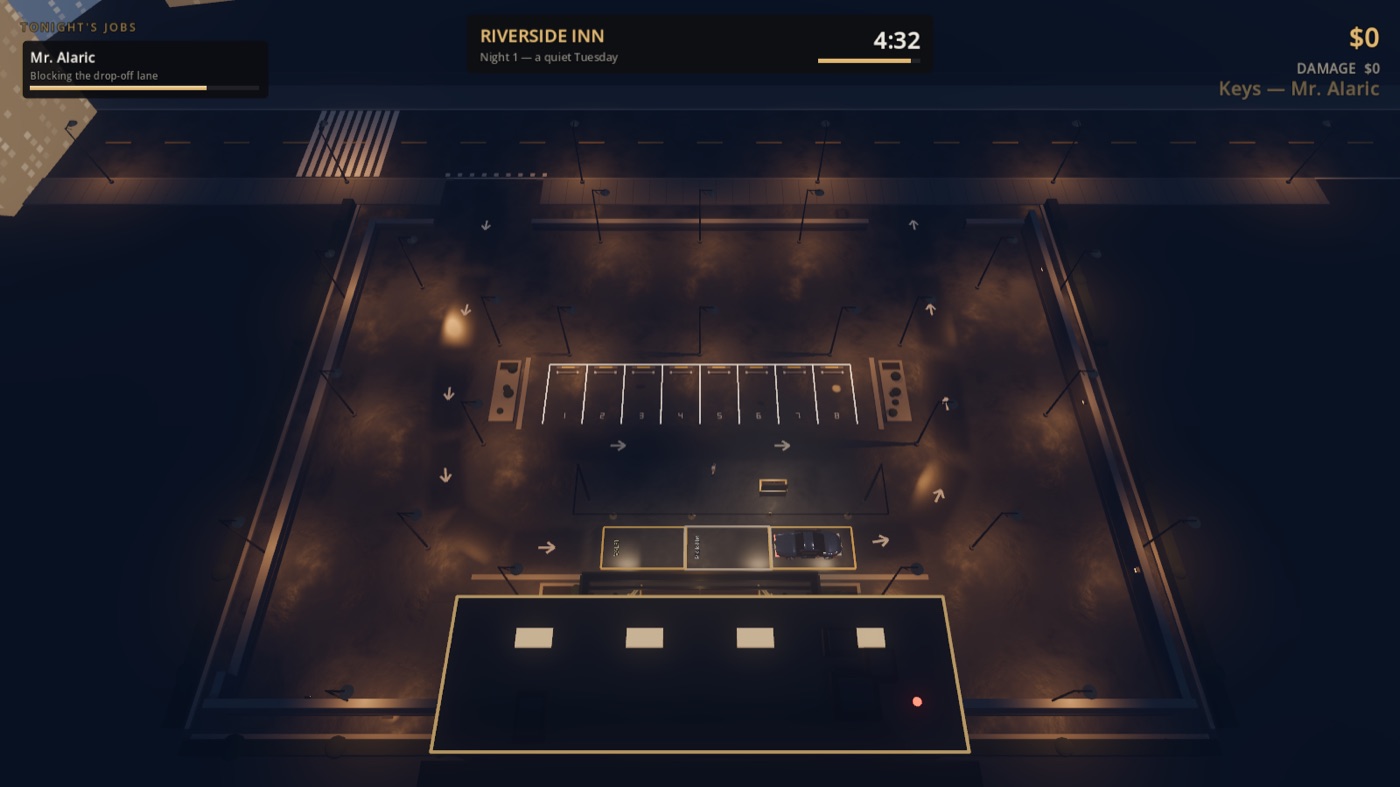
It starts at a quiet riverside inn. It ends at a casino forecourt in the rain.
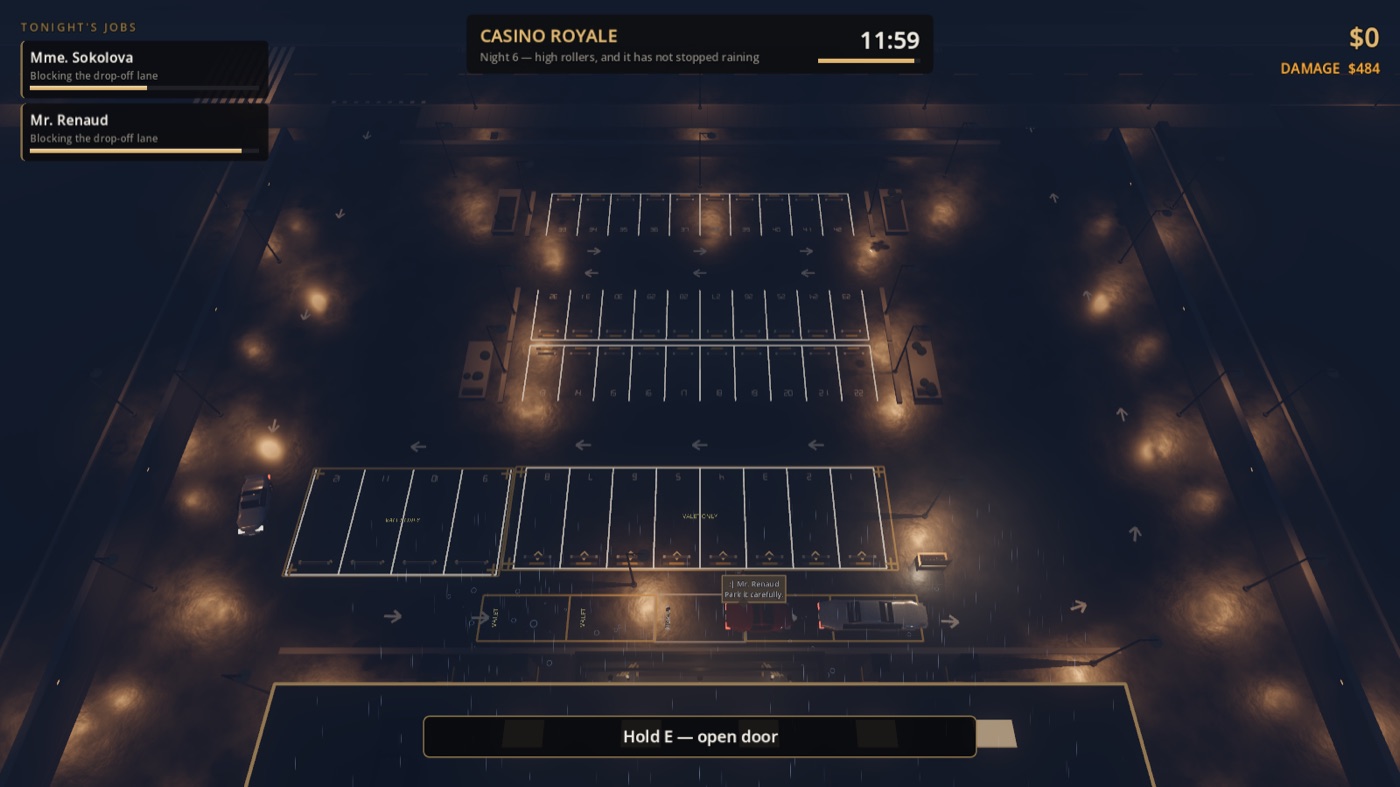
Twenty-eight guests, VIP-only bays, and a Lamborghini whose door costs more to fix than your entire shift is worth. In between: an airport long-stay, a hospital, an underground garage with a ceiling low enough to matter.
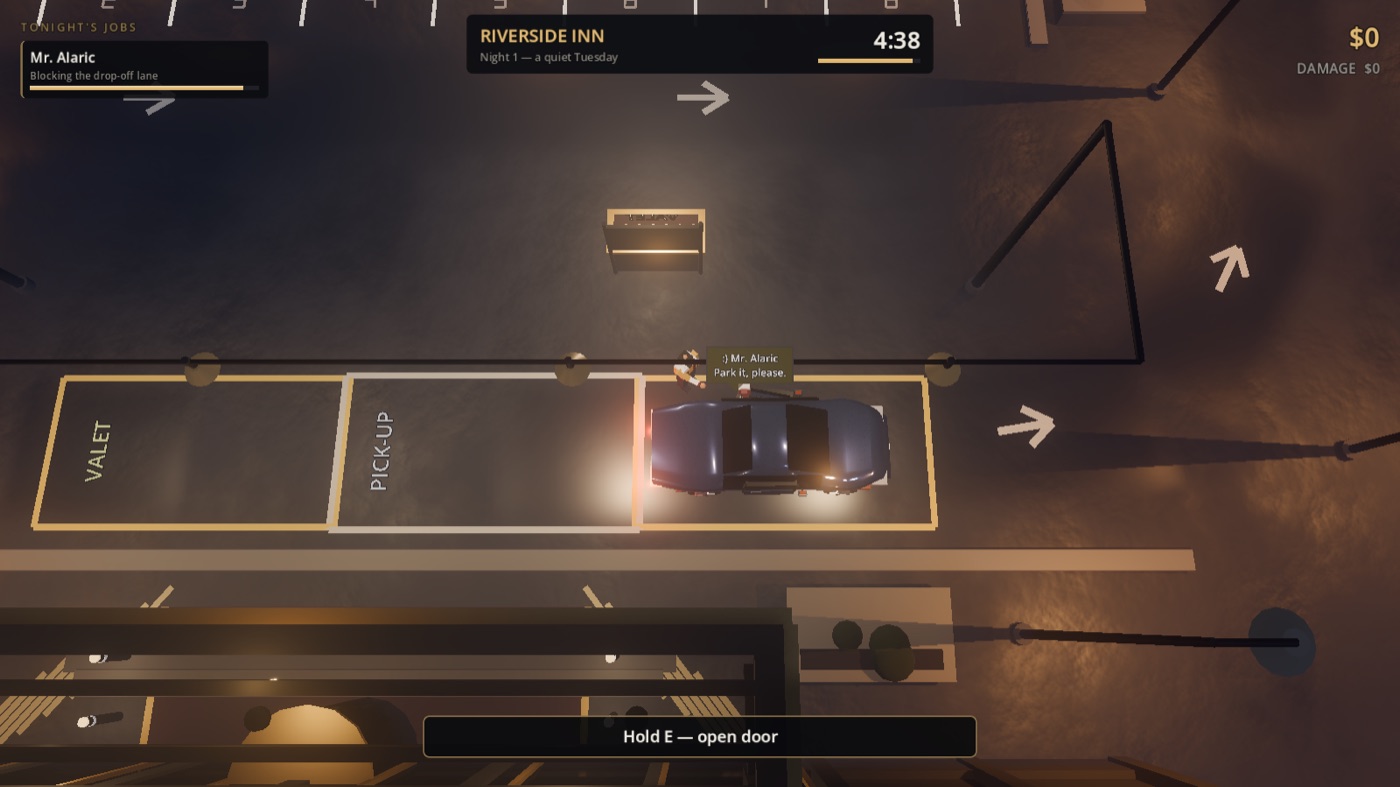
Guests pull up at the entrance, get out, and hand you the keys. You drive each car to a free bay, park it squarely between the lines, get out, and walk back. Later they come out and want it back, and you have a countdown to fetch it.
Three things carry the game
The cars are actually simulated
Every car is a rigid body on four raycast wheels with real spring/damper suspension, specified the way real suspension is — a ride frequency and a damping ratio. Tyres make longitudinal and lateral force separately and share a friction circle. So the body squats under throttle, dives under braking, leans in corners, and rocks twice after you clip a kerb. The SUV feels tippy because its centre of mass is at 0.74 m. None of it is animation.
Damage is real geometry
The body shell is a mesh lofted from cross-sections. Hit something and the vertices near the impact are pushed in along the impact normal, with noise on the falloff — so you get an irregular crease, not a smooth dimple, and it stays there for the rest of the day. Walls scuff your paint without denting it, because concrete doesn’t crumple. The bill scales with the car’s value.
The door is the game
You don’t teleport out. You hold a key and the door swings open gradually, swept against the world every tick. Park 20 cm from the neighbouring car and the door stops at 22° — not far enough to get out. Lean on it anyway and pressure builds until you ding them, which damages both cars and costs you money.
So you reverse out and try again
That is the loop nobody else makes you do. A bay you can reach is not the same as a bay you can leave. You will park a car perfectly, discover the door opens 18°, and back out to straighten up — or press Q and climb out the passenger side, which takes longer and sometimes isn’t any better.
Panel vans have sliding doors, so you can park those tight. Supercars have scissor doors, so lateral clearance is free — right up until the underground level, where the ceiling is low.
The pressure is a lane, not a timer
The drop-off lane holds a handful of cars. Fill it and arriving guests queue on the street, horns start, reputation bleeds, and everyone already waiting gets angrier. There is no lap time to beat. There is a lane you have to keep clear, and it is always the thing you should have done two minutes ago.
Tips come from how fast you were, how square you parked, and how happy the guest is. Repair bills are subtracted at the end of the night, which is where a good shift goes to die.
Six venues
- Riverside InnEight wide bays, five guests, a quiet Tuesday.
- City HotelTighter bays, a kerb you will find with a wheel.
- UndergroundLow ceiling. Scissor doors stop being a cheat code.
- HospitalAmbulance lane you are not allowed to block.
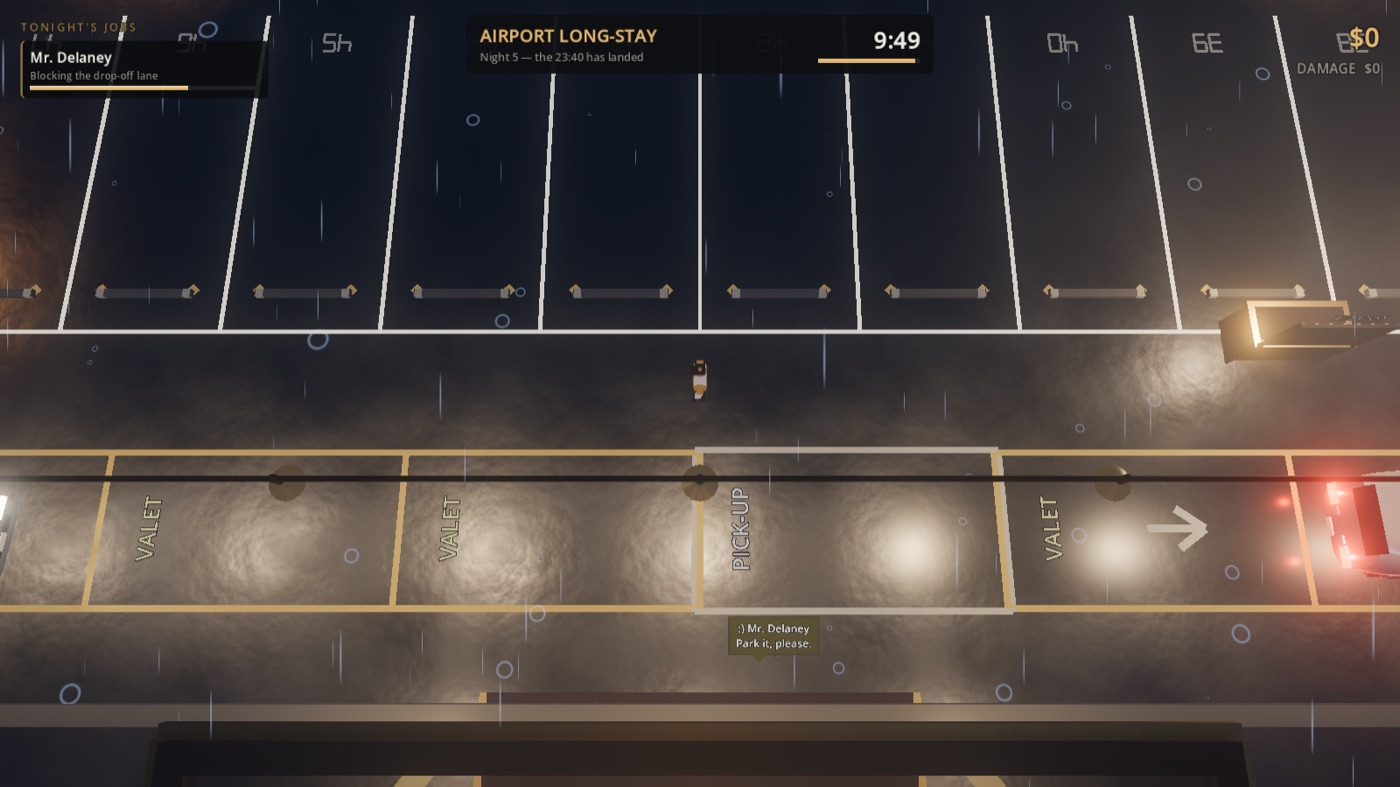
- Airport long-stayTwenty-plus arrivals and a rain that never stops.
- Casino RoyaleHigh rollers, VIP-only bays, and a very expensive Lamborghini.
Upgrades, bought between nights
Each one is wired to something you can actually feel, not a number on a sheet.
| Upgrade | What it changes |
|---|---|
| Running Shoes ×3 | The walk back is a real cost. This shortens it. |
| Valet Golf Cart | Ends the walk entirely. |
| Driving Gloves ×2 | Steering rate and low-speed precision. |
| Door Edge Guards ×2 | Dings cost less; doors open faster before they bind. |
| Parking Sensors ×2 | Proximity tone, and a projected clearance ghost. |
| Key Board & Radio | Highlights the best free bay and draws the route. |
| Tailored Uniform ×3 | Tip multiplier. |
| Insurance Policy ×3 | Cuts the repair bill. |
| Quick-Draw Keys ×2 | Faster in and out of the car. |
| Junior Valet ×2 | Parks one arriving car per shift. Badly. For free. |
Controls
| W A S D | Drive, or walk — camera-relative on foot. |
| Space | Handbrake. |
| E held | Open the door, gradually. This is the whole game. |
| Q | Use the other door. |
| Shift | Sprint. |
| H F | Headlights, horn. |
| Esc | Pause. |
| Mouse wheel | Zoom. The camera sits near-overhead with a 15° tilt — just enough to read door swing, body roll and the cones of the street lights. |
Everything here is built from code
There are no imported assets. Every car, every kerb, every painted bay number and every street lamp is generated at runtime from a spec — which is why the whole game downloads as half a megabyte of data sitting behind the engine. The cars aren’t models with damage states; they are meshes lofted from numbers, and the dents are those numbers being moved.
The browser build runs on WebGL 2 and is the same game as the desktop build, with the heavier lighting turned down — it ships with High quality already off, because the two effects that setting exists for, volumetric lamp beams and ambient occlusion, do not exist in a browser at all. On a desktop you can turn it on in Settings from the main menu; on a slow machine, turning it back off is the first thing to try.
Get it
Windows
One 37 MB executable, nothing to install alongside it. Runs the full lighting at full speed — this is the version to play.
Windows shows a “Windows protected your PC” notice the first time, because the build isn’t code-signed. More info → Run anyway.
Download .zipBrowser
Nothing to download and nothing to trust. Slower, and missing the two effects WebGL has no answer for.
Chrome, Edge, Firefox or Safari on a desktop. First load pulls about 40 MB of engine.
Play nowMac
Not yet. A Mac build has to be signed and notarised by Apple or macOS refuses to open it at all, and that certificate isn’t in place.
Until then the browser version is the Mac version, and it is the same game.
Play in browser